
The Quest of the Half Moon
The original Half Moon (Halve Maen) was commissioned on March 25, 1609, for the Dutch East India Company. She was a ship of exploration and the spaceship of her age, designed to take a crew of twenty into unknown and uncharted waters.
Her captain, Henry Hudson, was already a famous explorer of Arctic waters when in 1608 he was hired by the Dutch East India Company to find a Northeast, all-water route to Asia. But only a month out of port, the Dutch/English crew of his ship was disheartened after their passage north of Norway was blocked by Arctic ice floes. Many talked of mutiny.
Sitting in his cabin, the concerned captain considered his dilemma and options. A compromise was made. The course was changed, and what began as a search for a Northeast passage became a transatlantic crossing to look for a Northwest passage to the rich spice. trade of China. Of course, some think that Hudson's intention all along was to go Northwest.
Hudson in North America
After reaching the Maine coast, and replacing a foremast lost in rough storms during her Atlantic crossing. The Half Moon sailed southward as far as the present-day North Carolina Outer Banks. Then, turning northward, Hudson explored the Delaware Bay before arriving at the mouth of a wide river. Could this be a passage to the Pacific Ocean?
- Hudson stopped at points on the New Jersey coast before sailing the small ship up the river, which today bears the Captain's name--the Hudson River, but it was soon obvious that it was an inland river, not a westward passage.
- Hudson sailed upriver to present-day Albany before returning downriver, and claiming the region for the Dutch.
- It would be many years before the significance of Hudson's 1609 voyage to America would be understood, and the Half Moon would be universally recognized as one of the best-known ships of exploration.
America's Dutch Heritage
Hudson's voyage had important consequences. In making this historic journey, Hudson claimed the region for the Dutch and opened the land for the settlers who followed. Hudson's voyage, nearly ten years before the Pilgrims landed at Plymouth Rock, led to the establishment, in 1614, of the Dutch trading post, Fort Nassau, at present-day Albany, New York. The first European settlements in the States of Connecticut, Delaware, New Jersey, New York, and Pennsylvania were built by the Dutch beginning in 1624 and formed the Dutch colony of New Netherland, or Nieuw Nederlandt.
Echoes of Dutch Roots
By the end of the 17th century, all of New Netherland had become the possession of the British crown. Yet the maps of the region still reflect the original Dutch settlements. Brooklyn, Hoboken, Block Island, and hundreds more places take their names from the first Dutch colonists. These names hint at the early Dutch role in establishing our nation, an involvement that continues today.
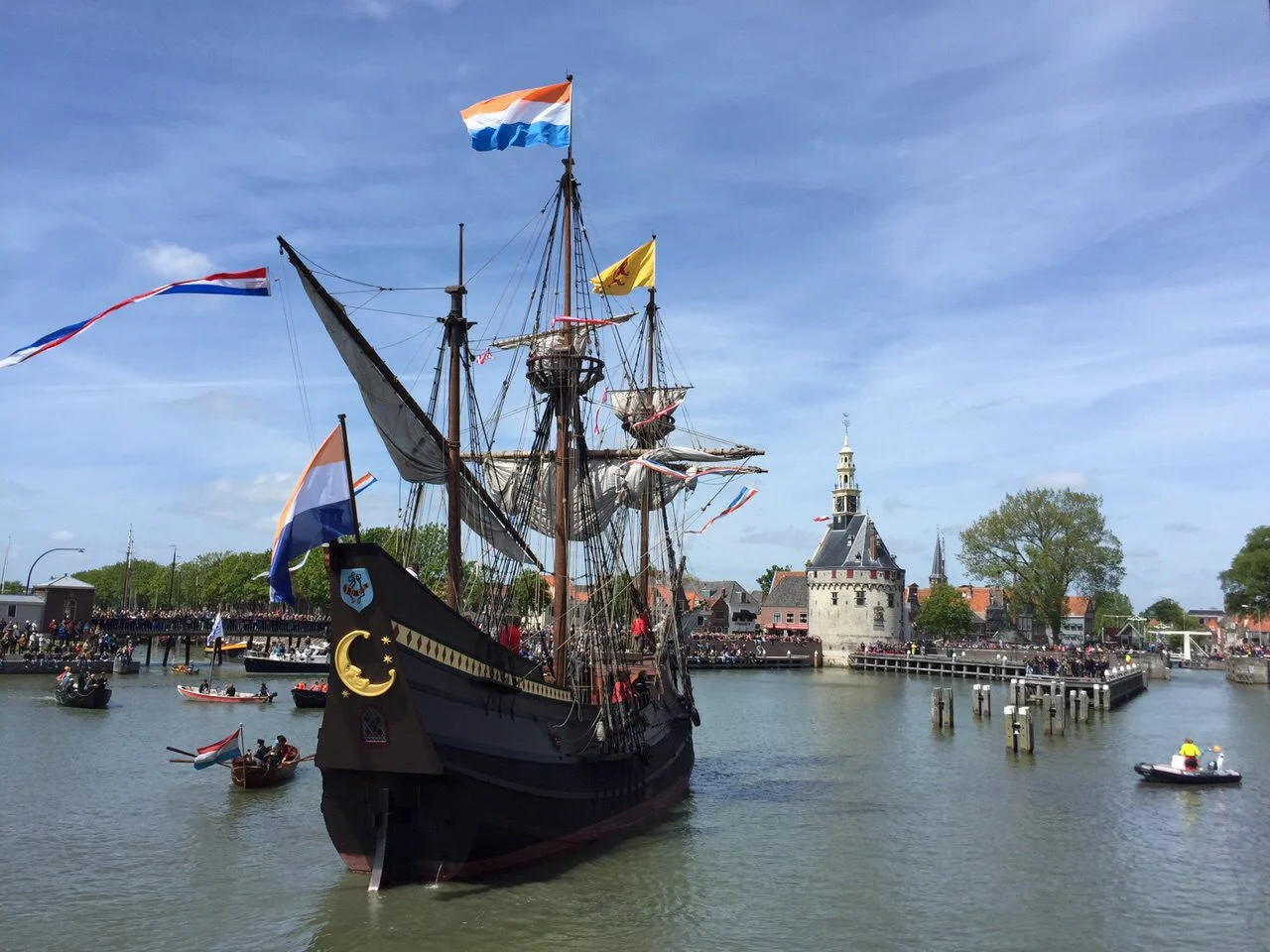
welcomed by The City of Hoorn, Netherlands, on May 23rd, 2014.
The Undeniable Influence
New Netherland's Influence on:
-

The Dutch Republic.

-
The Anglo-French invasion of 1672.
-
The House of Orange- Nassau.
-
The future United States.
The 1664 British capture of New Amsterdam and New Netherland in peacetime was one of the sparks that ignited the second Anglo-Dutch war. The English would pay dearly for their 1664 incursion, but the return of New Netherland to Dutch control was not among the conflict's peace terms as decided in Breda in 1667. The New Netherlanders would have to wait another five years for a brief reunion with their former mother country.
- The Second Anglo-Dutch War ended with the Peace of Breda in July 1667.
- The Netherlands placed a stranglehold on England, nearly bankrupting King Charles II, and sent a fleet up the Thames through the Medway to Chatham, destroying shoreline warehouses and the Chatham Naval Yard, which caused panic in London.
- The blockade brought London’s commerce to a standstill during the first half of the summer of 1667, severely reducing Charles II’s revenue.
- The Peace of Breda ended Dutch control over British commerce, granted the Dutch Suriname and other concessions, but did not return New Netherland.
- The Triple Alliance of 1668 between England, Sweden, and Holland reaffirmed cooperation among these Protestant states.
Charles II's humiliation was so thorough, however, that within two years he entered into a secret alliance with France's Louis XIV to once and for all crush the Dutch Republic.
- Over 100,000 French soldiers invaded the Netherlands and rapidly captured a succession of cities and provinces, all the way up to, and including, Utrecht.
- A joint English-French seaborne invasion fleet, however, was stymied at sea by Dutch naval fleets and never affected the activity on land.
- What was worse for England was that Charles II was about to see his revenue sources dry up suddenly, and this would directly affect the outcome of the new war.
After the disastrous (in the eyes of the British) end of the second Anglo-Dutch war, the merchant community (whose warehouses had been destroyed) could not nearly provide sufficient tax support to the British crown. Charles II's remaining revenue depended first on the Virginia tobacco trade, second, upon taxes and duties from the New World, and thirdly from revenue derived from the Newfoundland fisheries. The Dutch would swiftly move to end all three.
- In July of 1673, a combined Dutch fleet under Cornelius Evertsen and Jacob Benckes captured almost half of the annual Virginia tobacco fleet, and sank or scuttled half of the remainder.
- They then sailed north and quickly recaptured New Netherland and proceeded to lay waste to the coastal fishing towns in Newfoundland. (For additional detail, see "The Legacy of Peter Stuyvesant" elsewhere on this website.
- All British ships in the former New York (now renamed New Orange) were captured.
- British merchantmen that could escape Boston quickly did so, as rumors of an incredibly large Dutch fleet spread throughout New England.
- The Newfoundland fishing grounds were effectively shut down, while trade and commercial activity ceased.
- Most importantly, Charles II's revenue stream ground to a halt. From the perspective of the British crown, the whole of North America was threatened.
- Charles II couldn't release the fleets guarding the Thames for fear of a repeat performance of 1667, and the Dutch, in fact, tried to capture Sheerness at the mouth of the Thames again in 1672, but this time its defenses had been improved.
- The few reports that were received from the New World probably exaggerated the scope of the disaster, but New Netherland was again firmly in Dutch hands, and the reality of revenue loss was certain.
- When the first ship sent to inform the Dutch back at home was inadvertently intercepted and captured by the English, Charles realized the extent of the losses and, more importantly, could take advantage of a window of opportunity to conclude a peace with the Netherlands before the full impact of their victory in the New World could be realized by the Dutch negotiators.
The French, poised on the outskirts of Amsterdam, had been temporarily halted by the defenders breaking open the dikes and flooding the fields through which the armies had to cross. When the Treaty of Westminster was signed in 1674, English support of the French disappeared, and France advanced no further, eventually withdrawing. Thus, the Netherlands and the House of Orange were saved, but the New Netherland settlement again reverted to British control.
Fourteen years later, when William of Orange triumphantly accepted the British throne in the aftermath of the Glorious Revolution, Dutchmen again assumed control of New Netherland, this time under Protestant Jacob Leisler. William of Orange, however, interested in securing peace and cooperation among the English, allowed control of New Netherland to revert to their corrupt former governor, and in 1691, Leisler's rebellion, or King William's war, ended with the English again in authority over the region.
Having changed hands five times within a quarter century, the region's inhabitants were poised for the sixth change of control for the next two or three generations. This stimulated the former Dutch and English inhabitants to treat each other with enhanced respect, civility, and cooperation, greatly extending the length of Dutch influence in the New York area. Families such as the van Rensselaers, having survived the five transitions intact, wielded unusual influence well into the next two centuries.
The Dutch love for tolerance, free enterprise, free trade, and freedom of religion soon became entwined into the Colonial psyche that set the foundation for the American spirit of 1776. The "Apology" of William the Silent of Orange to Philip of Spain in 1581 blueprint the Declaration of Independence that followed almost two hundred years later, and the Dutch Republic that William headed was the only model available for the American patriots to follow. Thus, its preservation in the latter half of the 1600s would keep the model intact for Franklin, Paine, Jefferson, Adams, and Washington's benefit.
Some provisions of the surrender documents of Peter Stuyvesant in 1664 (e.g., prohibiting the quartering of soldiers in civilian homes) even found their way into the Constitution of the United States over 100 years later. What began with Henry Hudson's Halve Maen in 1609 ended up fully integrating into and inordinately influencing the future United States of America, while simultaneously contributing to the preservation of the House of Orange-Nassau and the Kingdom of the Netherlands.
The Legacy of Peter Stuyvesant
[This article appeared in the program of the Peter Stuyvesant Ball in 1995]
When New Amsterdam was beset by four English warships in 1664, Governor Peter Stuyvesant was reluctant to capitulate. The usual practice in those times was pillage and depredation by the victors, and Stuyvesant, at first, vowed to resist. He even tore up the original papers, some say without reading them, but the burghers pieced them back together and prevailed upon him to surrender.
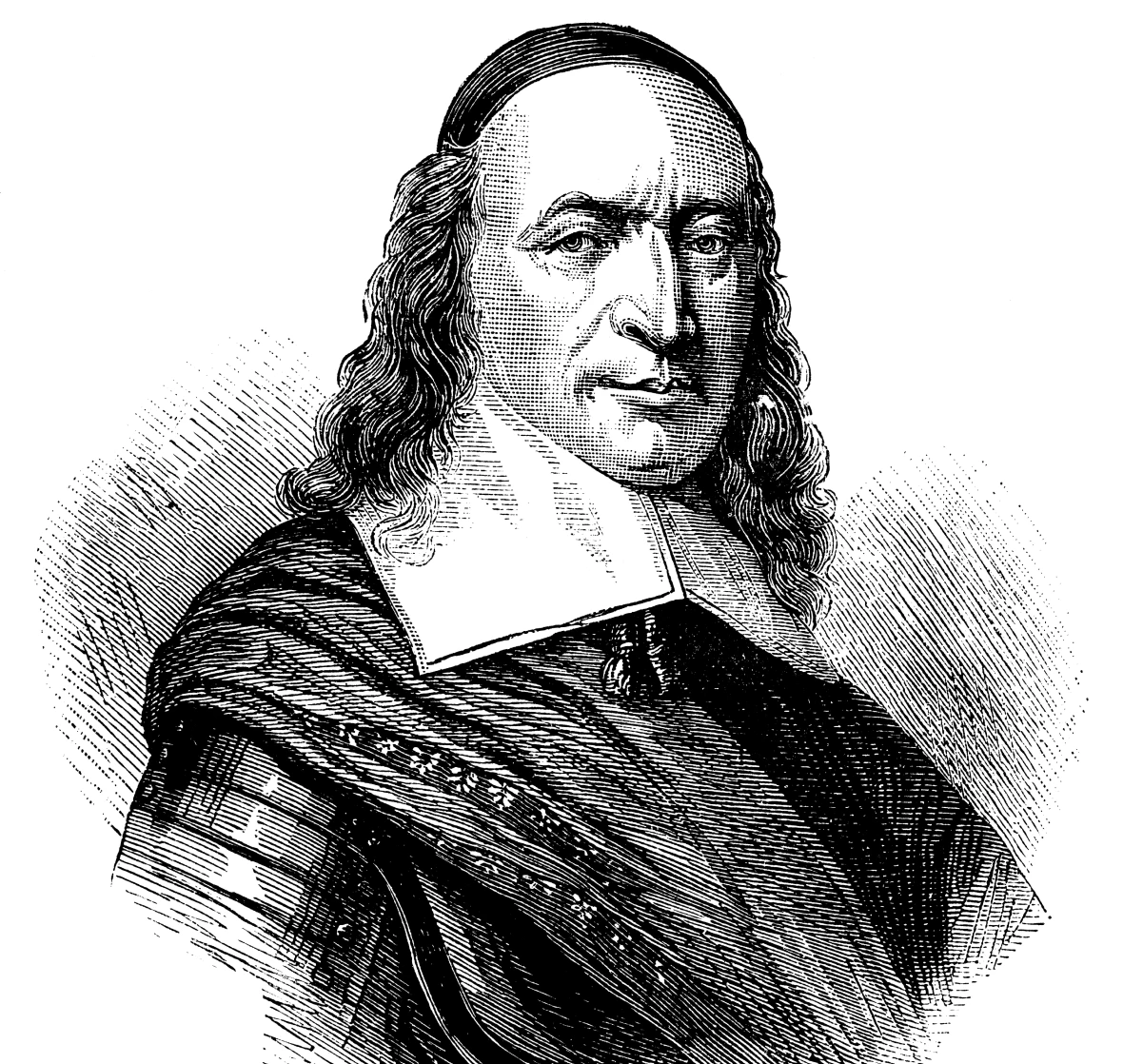
Peter Stuyvesant's gift to posterity was his eventual acceptance of the surrender terms. To be sure, the terms were exceedingly generous; 23 articles, each guaranteeing some aspect of freedom of worship, personal liberty, property retention, travel, etc., etc. Additional terms prohibited quartering soldiers in private houses without compensation, barred military impressment, and promised unrestricted trade with the former mother country, Holland.
Why such generosity? Maybe because the English attacked in peacetime (the first Anglo-Dutch war ended ten years earlier), or possibly because the English had but 300 soldiers to pit against thousands of Dutch burghers, or most likely because the Duke of York wanted to keep the colony intact, retaining its value to the British Crown. In any event, if Peter Stuyvesant surrendered, the settlers would be treated with exceptional benevolence.
- The surrender terms Stuyvesant accepted served the English well, for nine years later, during the third Anglo- Dutch war, two future Dutch Admirals would turn things around.
- Commander Cornelis Evertsen, a renowned Zeelander known to the English as "Kiss the Devil" (Kees de Duivel)*, combined his fleet with one out of Amsterdam under Captain Jacob Benckes.
- Together, they raided English and French Caribbean ports and captured or destroyed most of the Virginia tobacco fleet in the Chesapeake.
- By the time they anchored off Sandy Hook, their warships and captured armed merchantmen numbered 21 ships, by far the largest fleet ever assembled in North American waters in the 1600s.
English capitulation was swift.
- After cannon shots were exchanged, a 600-man landing party, augmented by at least as many armed townspeople, marched up to the fort, and New York was renamed "New Orange."
- Albany surrendered within two weeks, after a Dutch warship, the "Zeehond" (Seal, or Sea Dog), sailed upriver to add some persuasion.
- The same surrender terms that Stuyvesant agreed to were imposed again, but this time upon the English. Most importantly, life, liberty, and property were again respected, and Dutch civil authority was restored.
When the treaty of Westminster's terms took effect 15 months later, and New Orange became New York for the second time, Peter Stuyvesant's example was followed again, and the transfer was orderly and without incident. And in 1689, in the wake of the Glorious Revolution, when Jacob Leisler took control of New Netherland on (so he believed) behalf of William of Orange, life, liberty, and property were again respected. Two years later, English authority was restored for the last time, and with the exception of Leisler, under the same conditions.
- Five times in 27 years, the New Netherland region changed hands, and each time the legacy of Peter Stuyvesant held true.
- Without looting, burning, or any of the usual acts of plunder associated with power transfers in those times, the need to repair and rebuild was eliminated.
- Thus kept intact, Dutch-English cooperation lasted, and the New York region continued to grow and prosper, rapidly becoming the economic engine of the free world.
Of course, we know the name "Kees" has nothing to do with kissing, and the English knew that too. But they called Evertsen "Kiss the Devil" as a way of making fun of a name uncommon in England, and a way to demonize a formidable adversary for the benefit of the less well-educated seamen who served on British ships. Quite a number of English ships received Evertsen's "kiss" and either found their way to the ocean's bottom or were captured as prizes.
Blueprint for the Bill of Rights
The British frigate Guinea, along with three other warships, entered the lower Hudson River in late August 1664 and demanded that Peter Stuyvesant surrender New Netherland. The unprovoked, peacetime attack on New Amsterdam by Colonel Richard Nicolls, acting under orders from James, Duke of York, placed the English in control of New Netherland. Colonel Nicolls was a polished, able officer who spoke Dutch well and was charged to treat the inhabitants "with all humility and gentleness," with the objective of securing a peaceful conquest without unnecessary bloodshed.
Stuyvesant at one point said that he "...would much rather be carried out dead," but the townspeople pieced together the surrender terms that he had torn to bits, and along with the clergy, prevailed upon him to accept English occupation. (See The Legacy of Peter Stuyvesant for more detail on the capture (and later recapture) of New Netherland).
Colonel Nicolls, cognizant of his precarious legal position (peacetime attacks were considered nothing less than pure piracy), made the situation more palatable by allowing the garrison to march out of the fort, matches lit, and "with their arms, drums beating, and colors flying." In addition, Nicolls said that his capture was "subject to negotiations with the home governments." But what placated most were the surrender terms themselves.
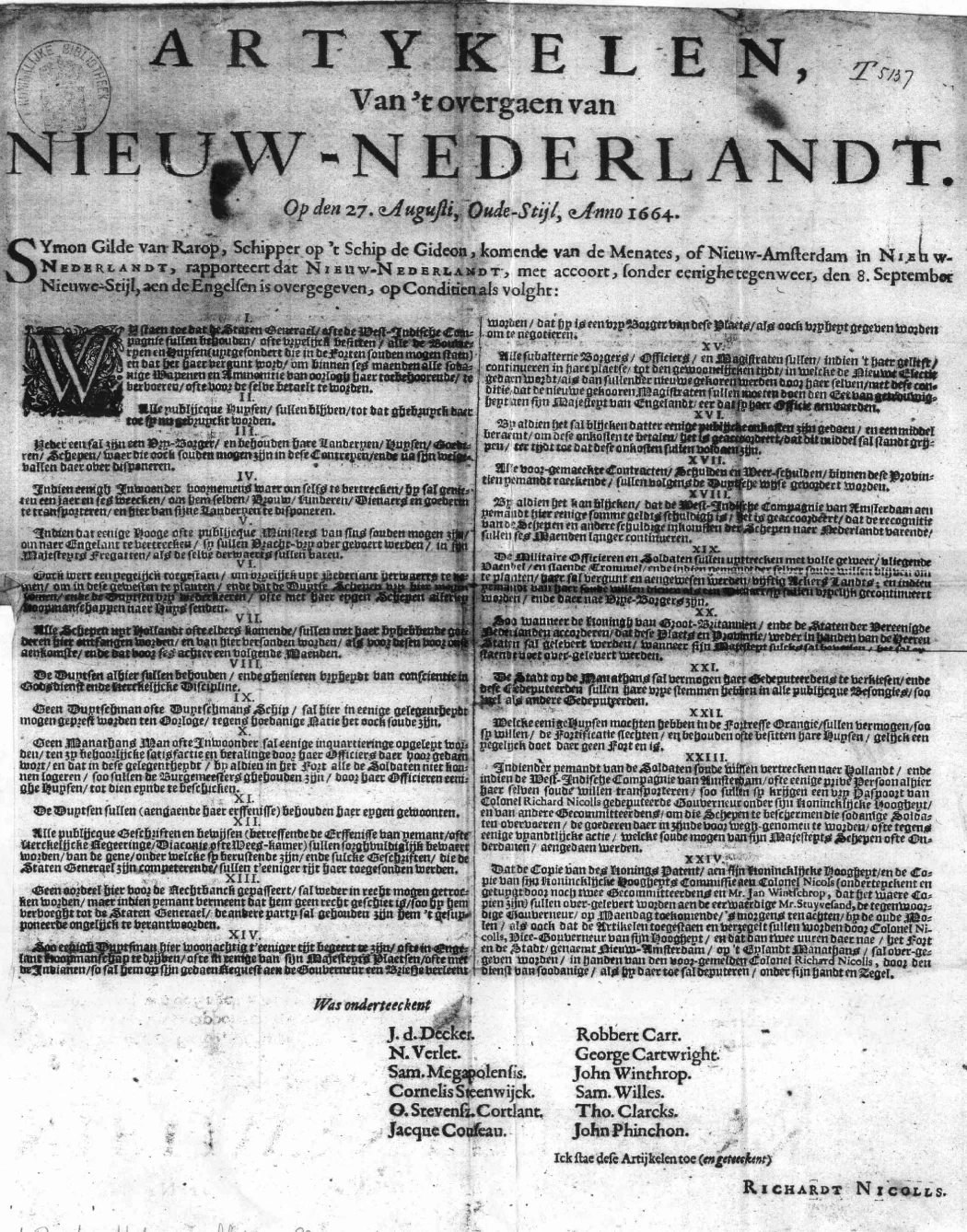
The Articles of Capitulation on the Reduction of New Netherland were filled with extraordinary generosity for their time. They had the (un)intended objective of securing a list of conditions that conferred rights upon the populace unheard of in those times. The irony, from a historical standpoint, is that the Dutch (and ex-Dutch) now would enjoy greater rights under the English Crown than those of any of the other colonial settlements, and many of these privileges, in one form or another, would last through the twentieth century!!! The Articles follow:
Articles of Capitulation - August 27, 1664 (Old Style)
The articles following were consented to by the persons hereunder subscribed at the Governor's Bowry, August 27th Old Style, 1664.
1. We consent that the States-General or West India Company shall freely enjoy all farms and houses (except such as are in the forts), and that within six months they shall have free liberty to transport all such arms and ammunition as now do belong to them, or else they shall be paid for them.
2. All public houses shall continue for the uses which they are now for.
3. All people shall still continue free denizens and enjoy their lands, houses, goods, shipps, wheresoever they are within this country, and dispose of them as they please.
The Duke's Laws and Legal Expansion
The following year, Colonel Nicolls expanded upon these articles and promulgated a code of civil and criminal law called the "Dukes Laws," which added the right of jury trials and required two or more witnesses or confession of the accused, before the death penalty could be imposed.
When the Dutch recaptured New Netherland in July 1673 and renamed it New Orange, the same rights were reiterated and upheld. After the Treaty of Westminster returned the settlement to England in November of 1674, the new governor, Edmund Andros, guaranteed that the residents of New Netherland again would have "...the same right, privilege and freedom which the said residents enjoyed before the ... war." In addition, the departing Dutch governor, Anthony Colve, got Andros to agree to eleven further articles, reasserting religious freedom and freedom from impressment, and assorted property rights for the inhabitants.
- In 1683, the New York representative assembly recodified the surrender documents and additions over the years into the "Charter of Liberties and Privileges," where, for the first time, the phrase "by due Course of Law" appeared.
- The Charter, signed by the Duke of York, was abrogated when the Duke became king as James II.
- But Jacob Leisler effectively reinstated them during Leisler's Rebellion or King William's War (1689-1691), as the colonial reaction to the Glorious Revolution was called.
- New Netherland basically had changed hands again for three years, and fell under Leisler and his Protestant rule, awaiting the triumphant blessing of William III of Orange, the Dutch Stadholder who succeeded to the English throne.
- William's blessing never came, as Andros, who had fled to Britain, petitioned the new monarch to assist in an orderly return of New York/New Netherland to the crown.
- William did just that, not knowing that "King William's war" had been fought against the corrupt Andros, and for the Protestant William. Andros accepted the Charter's reinstatement, as did his replacement, Governor Benjamin Fletcher.
- King William, however, declared the laws invalid in 1697, but Fletcher's replacement, the Earl of Bellomont, in 1698, brought the former supporters of Leisler back into power, and with them came adherence to the same rights and freedoms again.
In the next century, when the American Revolution's success prompted adoption of a new Constitution, it was the New York delegation, under their able, yet anti-federalist governor George Clinton, that insisted on passage of the first ten amendments, the Bill of Rights, before they would grudgingly agree to ratify the new Constitution. Having spent the last century living under laws directly descended from the Stuyvesant surrender terms, the New York representatives would not tolerate anything less than the freedoms that we, today, have taken for granted.